Hän is the inclusive Finnish pronoun that stands for equal opportunity. It's a symbol for a better world where people are not defined by their background, gender or appearance.
Equality is a core value for Finland and its people.
Finland wants to highlight the important work that is being done every day to promote equality-related values in society, around the world.
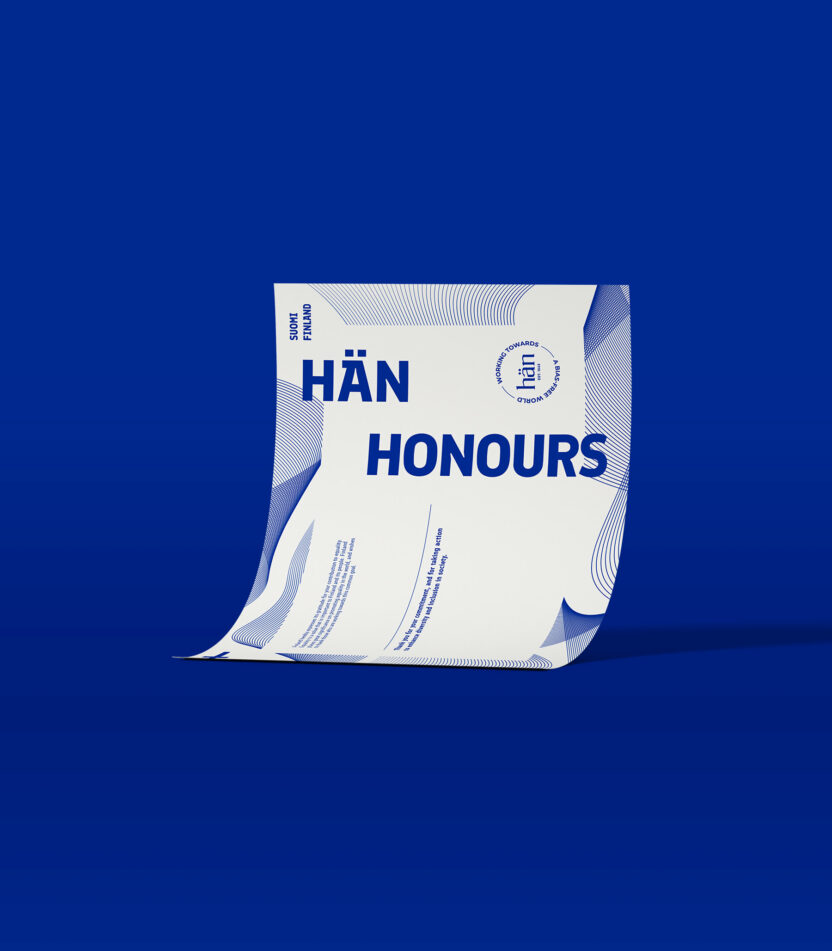
Here is a list of the Hän Honours that Finland has presented so far.
The Manuela Ramos Movement is a Peruvian organization that has been working since 1978 through various initiatives and projects to promote women's rights, especially those of women in vulnerable situations. They carry out prevention and support programs against gender-based and sexual violence; initiatives to combat discrimination in all its forms; and campaigns and actions to strengthen women's economic autonomy and leadership.
Vice Minister Gloria de la Fuente is recognized internationally for her key role in advancing Chile’s feminist foreign policy and integrating gender equality into the country’s foreign and development agenda, helping secure global acknowledgment for this progress.
Teresita Antazú is a renowned defender of the rights of the indigenous peoples of the Peruvian Amazon. From a young age, she fought against the inequalities faced by indigenous women in her community and was the first woman "cornesha," the highest authority in the Union of Asháninka-Yanesha Nationalities (indigenous). She promotes the political participation and leadership of indigenous women. Her work focuses on the defense of Amazonian territory, gender equality, and the protection of Peru's native cultures.
Stemettes is an award-winning social enterprise working across the UK & Ireland and beyond to inspire and support girls, young women and non-binary young people into Science, Technology, Engineering, Arts and Maths careers (known collectively as STEAM).
In Iran, UNFPA supports reproductive health care, including for HIV/AIDS and other vulnerable groups, and reproductive health responses in emergencies. UNFPA also supports the government to address emerging population issues, including youth and ageing, female-headed households.
Q&A
Hän is both ‘he’ and ‘she’ at once – or any other gender. It’s the inclusive Finnish personal pronoun that symbolises equal opportunity.
It symbolises a better world, where people are not defined by their background or appearance. Hän doesn’t pay attention to your gender, or your social status.
Finland wants to introduce this word – and the thinking behind it – to the rest of the world. There is still much to be done to promote inclusivity and equality, so let’s work together for a bias-free society!
The pronoun hän appeared in 1543 in The ABC Book, the first printed book published in Finnish. However, hän has, of course, been part of the language since the beginning of spoken Finnish.
Over the centuries, the meaning of the word hän has shifted. Before the 19th century, the pronoun was even more inclusive than it is now, since it was also used, among its other meanings, when talking about animals. As the project of creating a standardised, written form of Finnish began, the word received a new, more specific role: hän became the pronoun that distinguishes humans from animals.
Finland uses the word hän as a symbol for equality in Finnish society. We use it as a tool for talking about a complex, multifaceted subject.
It is true that Finnish is not unique in terms of having a gender-neutral pronoun. According to a study that covers around 400 spoken languages, the majority of those languages – as much as 67% – are like Finnish in this sense. Gender-neutral pronouns are typical of Finno-Ugric languages as well as Sino-Tibetan, Altaic and Bantu languages.
However, Indo-European languages, such as English and Spanish, typically have gendered pronouns.
No. Languages are full of gendered, covert meanings, and no word can guarantee an inclusive society. Despite the lack of grammatical or natural gender, the category of gender is expressed in many ways, and so is inequality between genders; the Finnish language is no exception.
For example, many professional titles are gendered in Finnish. In 1990, Statistics Finland published a directory of titles, and almost 400 of these titles ended in “-man” (-mies in Finnish), such as “fireman” (palomies).
It has even been suggested that the gender-neutral pronoun works against gender equality by rendering women invisible in public discourse. In languages with natural gender, such as English, it is possible to come up with alternatives to sexist expressions. For instance, “s/he” simultaneously denotes males and females. This increases the linguistic visibility of women.
Finnish linguist Mila Engelberg, PhD, is the author of a 2018 book whose Finnish title translates to “Men and Female People – Sexism in the Finnish Language and its Dismantling.” She writes: “What is more difficult is to recognise and dismantle the gendered, covert meanings of words, or to give up idioms suggesting that all humans are men. Dismantling linguistic sexism still requires both analysis and concrete action.”
Nonetheless, the power of an inclusive personal pronoun should not be trivialised. Speaking in an inclusive manner is easy in Finnish, since there are no grammatical genders, and the personal pronoun hän refers to women, men and non-binary people alike.
We do not claim that Finland is a perfect country in terms of equality. We recognise that discrimination based on, for example, gender, race, ethnicity and disability has been brought to light by women and minorities in Finland.
For example, various interest groups have called attention to breaches in the rights of transgender, Roma and Sámi people, and to the difficulties that people with disabilities face, for example, in finding employment in Finland. Nor is racism unknown in Finland, unfortunately.
Although there are 93 women in the 200-seat Finnish Parliament, women are still a minority in leadership positions in listed companies, media and politics. There are structural differences between pay levels in industries dominated by one gender: on average, salaries are higher in industries dominated by men, and men make more money than women in Finland. Moreover, violence against women continues to be a critical issue.
Tangible progress is being made in all of these issues, but they deserve continual attention and require work towards improvement.